Why Grasshopper Remains a Powerful Tool for Architects in the AI Era
“AI can create stunning images instantly, so do I really need to learn complex Grasshopper?”
“Text-based coding like Python seems more efficient, so why bother learning Grasshopper?”
If you’re studying computational design, you’ve probably asked these questions at least once. Technology evolves so rapidly that this article will likely become outdated someday. Nevertheless, I want to document my thoughts based on my experience as a computational designer at this point in time.
To cut to the chase, I believe Grasshopper will remain, and will continue to be, an extremely powerful tool for architects and designers. This is because it plays a crucial role in enabling not just complex form-making, but ‘expansion of thinking’, ‘precision in construction’, and ‘integrated design’.
Three Reasons Why You Should Learn Grasshopper
Before discussing AI, it’s necessary to understand why Grasshopper itself is a powerful design tool.
1. Intuitive Control and Immediate Feedback
Grasshopper’s greatest strength is ‘immediate visual feedback’. Rather than executing code and waiting for results, you can see geometry change in real-time in the Rhino viewport the instant you move a number slider. This provides the most intuitive environment for designers to continuously dialogue with ideas and develop designs.
2. More Efficient Than Code: ‘Function Bundles’
From a pure ‘data processing’ perspective, Python might be more efficient. However, Grasshopper components aren’t just single lines of code, but highly compressed ‘function bundles’. For example, a single Loft component contains vast amounts of code including complex geometry calculations, various options, and exception handling. This allows designers to focus solely on design logic itself rather than code development.
3. Infinite Extensibility for Integrated Design
 Computational Design of the Smart Slab. (Andrei Jipa ❘ dpt)
Grasshopper’s functionality expands infinitely through numerous third-party plugins like Karamba (structural), Ladybug (environmental), and Kangaroo (physics simulation). Architects can use Grasshopper not as a simple form-generation tool, but as an ‘integrated design platform’ that analyzes and optimizes performance from the early design stages.
Grasshopper’s New Role in the AI Era
Recent AI developments are not the end of Grasshopper, but rather opening new roles and possibilities.
1. A Tool to Transform AI ‘Ideas’ into ‘Architecture’
Image-generation AI provides amazing ‘ideas’, but the results lack key elements needed for actual ‘construction’ (precise dimensions, materials, structural logic). Architecture isn’t just about form, and must necessarily consider realistic constraints such as construction tolerances affecting details. The most realistic workflow to bridge this gap is as follows:
AI Ideation → Grasshopper Development → BIM Modeling
- Get Inspiration from AI (Ideation): Use AI-generated images or masses as inspiration for initial design.
- Architectural Reinterpretation with Grasshopper (Development): Designers use Grasshopper to reinterpret and materialize AI ideas into buildable, precise geometry. Construction-conscious details and data are added at this stage.
- Quick Conversion to BIM (Documentation): The completed Grasshopper model is data-driven, so it can be efficiently converted to BIM data through tools like Rhino.Inside.Revit, connecting to detailed design and construction phases.
Grasshopper can thus serve as the ‘core hub of practical workflows’ that implements AI ideas into actual buildings.
2. Data Scarcity: The Role as a Data Generation Engine
Furthermore, AI applications can extend beyond form generation to various architectural processes like drawing review, code checking, and layout automation. But the biggest barrier AI faces in all these areas is the ‘lack of quality data’ for training. This is precisely where Grasshopper presents new possibilities. Grasshopper’s parametric control capabilities enable architects to directly become ‘Data Generators’.
For example, you can automatically generate thousands or tens of thousands of apartment floor plan alternatives that satisfy specific regulations and conditions, and label data analyzing each alternative’s performance (sunlight, views, etc.). This generated and augmented data becomes the ideal material for training AI models with specific purposes (e.g., floor plan optimization AI). Therefore, Grasshopper isn’t simply a tool to receive AI output, but will perform the role of an active partner that generates and supplies data so AI can perform more architectural work.
Case Study: How Zaha Hadid Architects Teaches ‘Architecture’ to Generative AI
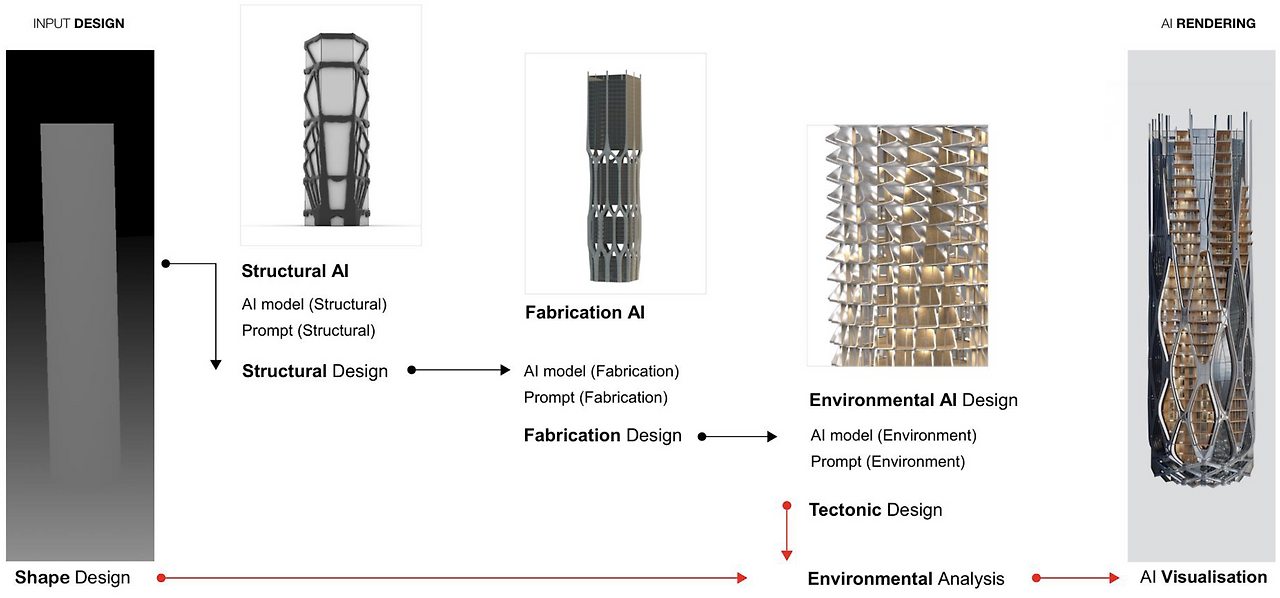 Proposed Workflow for Diffusion Model (Zaha Hadid Architects)
At Autodesk University 2024, ZHA introduced a case using Grasshopper as a data generation engine to teach AI ‘architecture’. To teach their design language and philosophy called ‘Tectonism’ to a Diffusion Model, they attach ‘architectural tags’ such as building program, structure, materials, and fabrication methods to 3D models, and build ‘performance-validated’ datasets through structural and environmental simulation. ZHA’s custom AI trained on this data gains competitiveness as a partner that understands architectural logic considering construction, beyond simply mimicking superficial style. This is a case proving that Grasshopper can become a tool for creating more intelligent architectural AI. It creates opportunities for architects or computational designers to expand imagination and implement the ability to independently create AI models. (More details available in Autodesk University materials.)
3. Goal-Oriented ‘Optimization’ vs. Possibility-Exploring ‘AI’
Another strength of Grasshopper is its easy integration with ‘optimization algorithms’. This contrasts with AI’s approach.
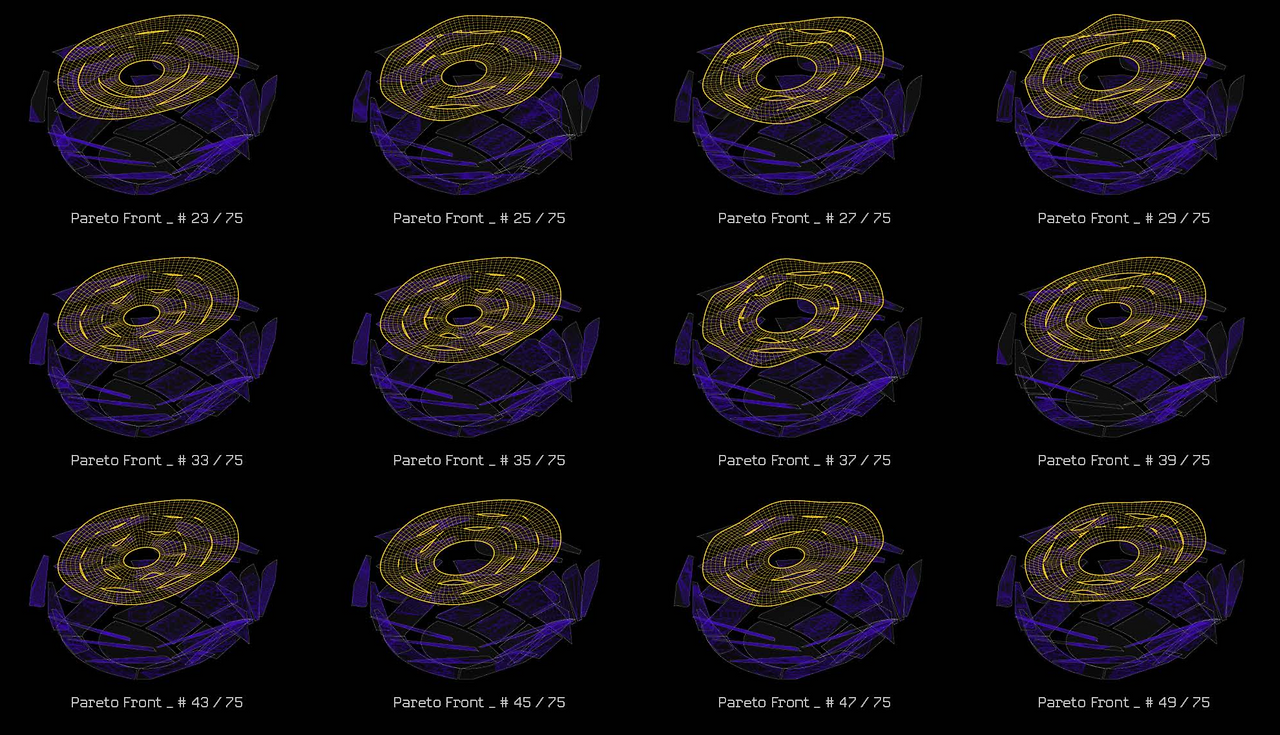 Optimal designs (Pareto Front) for concert hall acoustic reflectors found through genetic algorithms (author’s graduation project)
Optimization (Genetic Algorithm, etc.): Goal-oriented search. Optimization using Grasshopper plugins like Galapagos or Wallacei is a method where designers set clear ‘Objectives’ and ‘rules (Variables & Constraints)’. For example, if you provide specific goals like “optimal PV placement angle that minimizes solar radiation to reduce cooling load but maintains high indoor sunlight,” the algorithm searches for the best results satisfying these conditions among countless alternatives. Designers have the initiative in problem definition.
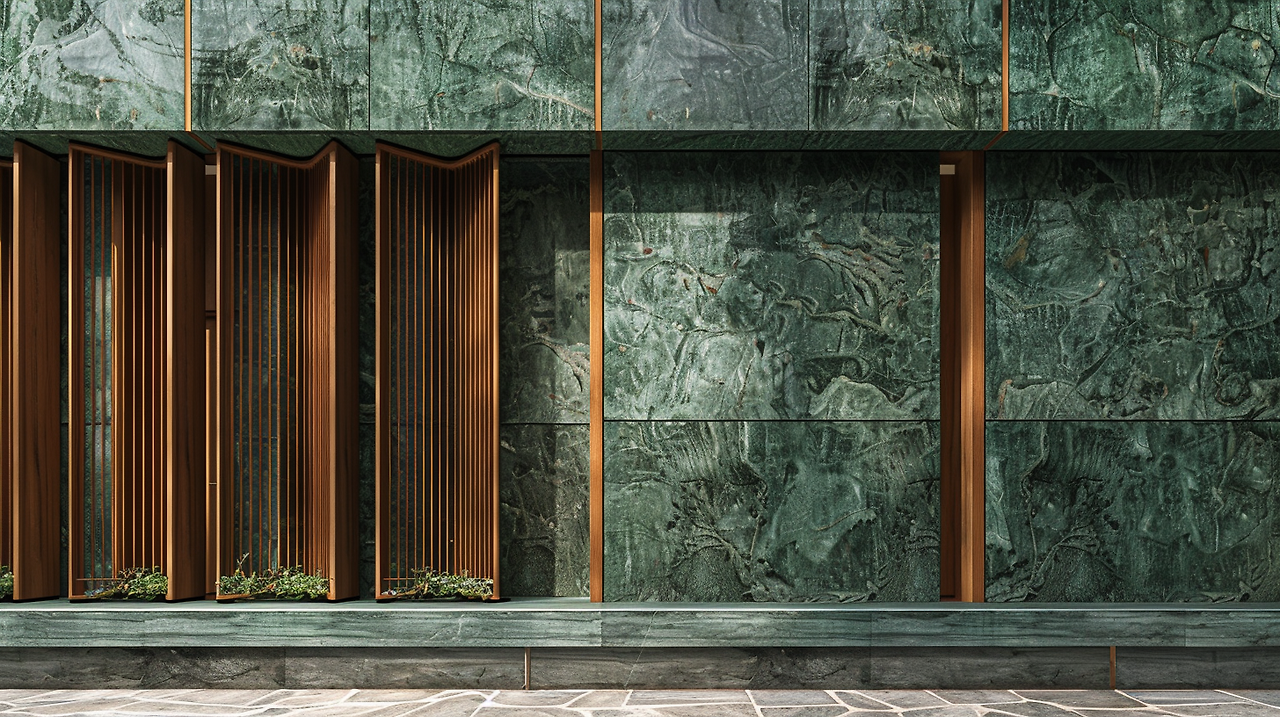 Images generated to test various material combinations (Midjourney)
AI (Generative AI): Possibility exploration. Current generative AI specializes in showing ‘plausible’ new possibilities based on learned data. When you throw abstract keywords like “museum with sun and mountain motifs,” it generates plausible images. While helpful for creative ideas, it doesn’t guarantee building performance or efficiency. These two are not in a replacement relationship but a complementary relationship. Workflows that set specific goals in Grasshopper and optimize inspiration gained from AI can create very powerful synergy.
Going further, you can maximize efficiency by integrating machine learning (ML) into the optimization process. Generally, structural or environmental simulation can take several minutes to hours per run, making it difficult to apply directly to optimization processes requiring tens of thousands of iterations. This is where machine learning techniques like regression models are used. After pre-calculating simulation results, you train a machine learning model on this dataset to create a ‘surrogate model’ that quickly ‘predicts’ simulation results. By integrating this prediction model into the optimization process, designers can perform work that previously took hours in just minutes, finding optimal solutions in much broader design exploration spaces. This is a very powerful methodology that enables exploration of more possibilities beyond time and resource limitations.
Result
Will You Be a Blind Follower of AI, or Use It as a Partner?
AI technology will automate much of the design process. With new AI models pouring out daily, it’s cautious to make definitive statements, but one thing seems certain. In this flow, architects must choose whether to become ‘followers’ who passively follow AI-proposed results, or use AI as a powerful ‘partner’ to implement their own design philosophy. To become a partner, you must develop areas AI doesn’t understand: ‘problem definition ability’ and ‘goal-setting ability’. The ability to define what makes a good building, and to prove and realize it with computational tools. This is precisely why we must continue studying logical design tools like Grasshopper in the AI era.